Vectorless RAG: Rethinking How We Retrieve Knowledge for LLMs
Traditional vector-based RAG struggles with structured corporate and legal documents where document hierarchies hold critical context. Vectorless RAG addresses this by leveraging document structure as a navigation map to route queries and pinpoint exact evidence for LLMs.
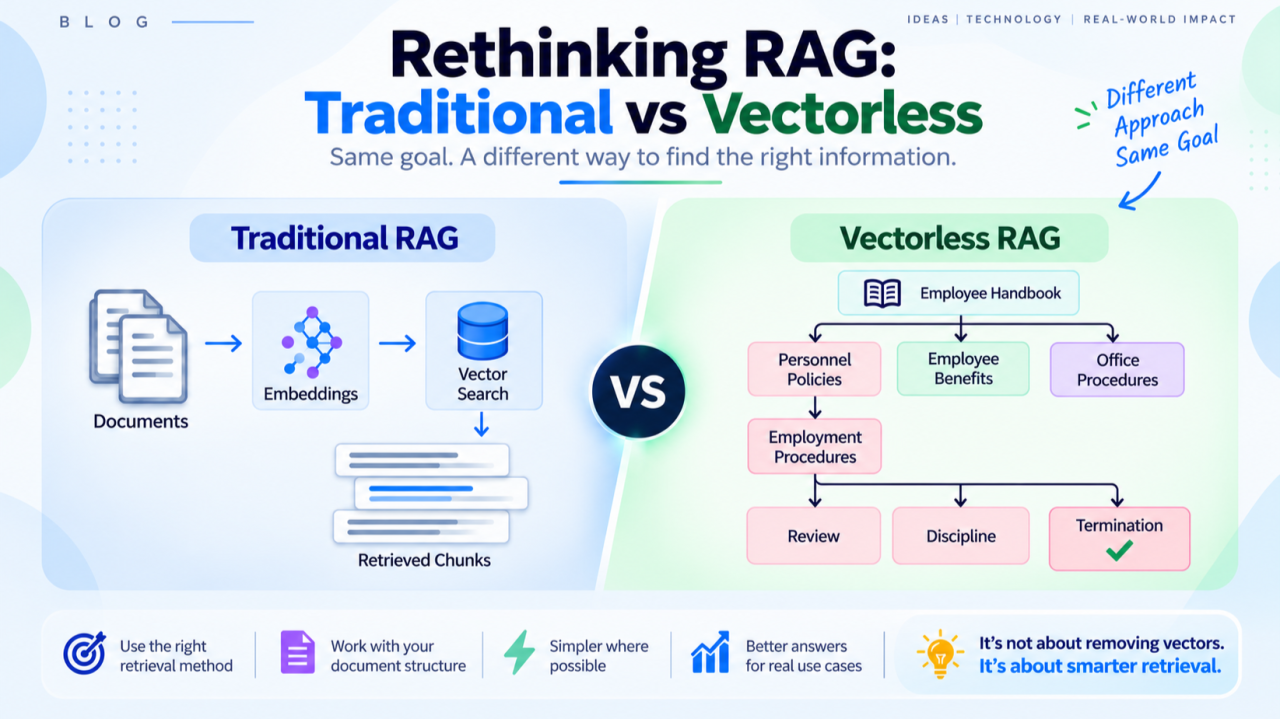
Overview
Retrieval-Augmented Generation (RAG) is the foundational design pattern used to connect Large Language Models (LLMs) to private, domain-specific data sources. The canonical pipeline relies on chunking documents, generating dense vector embeddings via models, and storing them in vector databases for similarity search. While this excels with unstructured data, it introduces inherent limitations when dealing with structured documents like policy manuals, financial reports, legal contracts, and API specifications.
Structured documents already contain explicit hierarchies—chapters, sections, subsections, and clauses—that dictate where specific information lives. Vectorless RAG shifts the paradigm from blind semantic similarity chunking to structural routing, using the document's native layout as a map to navigate directly to the correct evidentiary section.
Key Technical Insights
- The Limits of Semantic Similarity: Vector search retrieves chunks based on mathematical proximity in embedding space. However, semantic relatedness is not the same as evidentiary precision. A query about employee termination may surface resignation notices, disciplinary policies, and notice periods, creating noise rather than precise context for the LLM.
- Leveraging Document Hierarchy: Structured domains inherently encode intent in their table of contents and heading hierarchies. Humans naturally look up the 'Disciplinary Policy' section when asked about termination conditions rather than scanning every paragraph.
- Hybrid Philosophy: Vectorless RAG is not about discarding vector databases entirely, but about choosing the optimal retrieval primitive based on data typology. Unstructured knowledge bases benefit from vectors, whereas highly structured compliance and policy manuals benefit from structural navigation.
Implementation Details & Trade-offs
- Query Routing vs. Similarity Search: Instead of vectorizing every single token chunk, Vectorless RAG utilizes an intelligent routing layer to parse user intent and map it to specific nodes in the document's tree structure.
- Context Precision: By minimizing extraneous chunks retrieved during the search phase, token utilization is optimized, and hallucinations caused by irrelevant contextual noise are significantly reduced.
- Maintenance Overhead: While traditional RAG automates ingestion via basic chunking scripts, Vectorless RAG requires robust parser pipelines to correctly interpret document trees, markdown headers, and relational XML/JSON metadata.
Practical Takeaways
- Audit your knowledge base to distinguish between unstructured text corpora and hierarchical policy or legal documents.
- Implement hierarchical routing agents or metadata filtering alongside standard vector pipelines to improve retrieval precision.
- Focus on evidence-driven retrieval design: target the exact paragraph containing the answer rather than flooding the LLM context window with semantically related noise.