Back to All Blogs
LinkedIn Article 5 min readSeptember 8, 2026

Vectorless RAG: Rethinking How We Retrieve Knowledge for LLMs

Traditional vector-based RAG struggles with highly structured documents like policy manuals and legal contracts where hierarchy contains critical context. Vectorless RAG introduces structural document navigation as a map to route queries directly to relevant sections, achieving higher retrieval precision for organized data.

#Generative AI#RAG#LLMs#Information Retrieval#Vector Databases
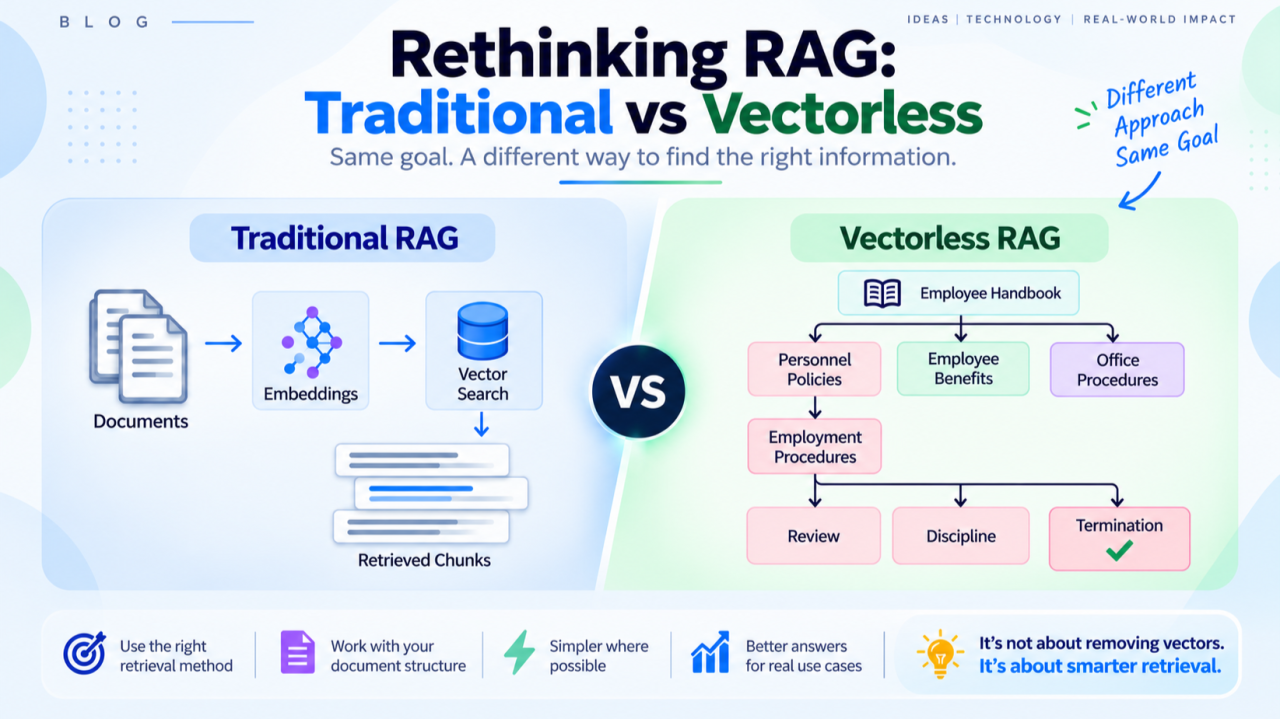
Vectorless RAG: Rethinking How We Retrieve Knowledge for LLMs

Overview & Architecture

Retrieval-Augmented Generation (RAG) is the standard pattern for grounding Large Language Models (LLMs) with private or domain-specific data. The conventional workflow relies heavily on vector embeddings and vector databases: documents are split into flat chunks, converted into dense vectors, and retrieved using mathematical similarity against a query vector.

While this vector-centric approach excels at processing large collections of unstructured data, it hits a wall with structured documents such as policy manuals, API documentation, financial reports, and legal contracts. These documents possess an inherent hierarchy (chapters, sections, subsections, and clauses) that inherently guides where specific answers reside. Vectorless RAG shifts the paradigm by treating document structure as a navigation map rather than reducing everything to flat semantic chunks.

Key Technical Insights

  • The Limitation of Pure Similarity: Semantic similarity measures proximity in vector space, which often retrieves related conceptual text (e.g., resignation policies, notice periods, and disciplinary actions) without isolating the exact evidentiary paragraph required for a specific question.
  • Document Hierarchy as a Routing Map: Structured documents provide explicit pathways. Instead of scanning every paragraph, a query can be intelligently routed through chapters and sections.
  • Complementary Retrieval Strategies: Vectorless RAG does not render vector databases obsolete; rather, it highlights the need for hybrid architectures. Traditional RAG is optimal for unstructured corpora, whereas structured navigation excels when organizational hierarchy and logical relationships dictate precision.

Implementation Details & Trade-offs

  • Granularity vs. Context: Flat chunking in vector RAG risks losing overarching structural context, often requiring complex parent-child chunking strategies. Vectorless RAG preserves the tree-like structure of the source material.
  • Preprocessing Overhead: Implementing a vectorless approach requires parsing documents into structured nodes (e.g., Markdown headings, JSON schemas, or ASTs) prior to query routing, trading upfront ingestion complexity for runtime precision.
  • Hybrid Routing Layer: Modern enterprise RAG systems should implement a router that inspects the query intent and decides whether to dispatch it to a vector similarity engine or a structural navigation parser.

Practical Takeaways

  • Evaluate your corpus: If your enterprise data consists heavily of structured manuals or contracts, leverage structural routing instead of forcing everything into vector embeddings.
  • Combine approaches by using semantic search to find the right document, followed by structural navigation to find the exact paragraph.
  • Focus retrieval engineering on finding precise evidence rather than broad semantic clusters to reduce LLM hallucination and context window bloat.