Back to All Blogs
LinkedIn Article 5 min readJuly 5, 2026

Why Does LangChain Exist? Understanding LLM Orchestration From the Ground Up

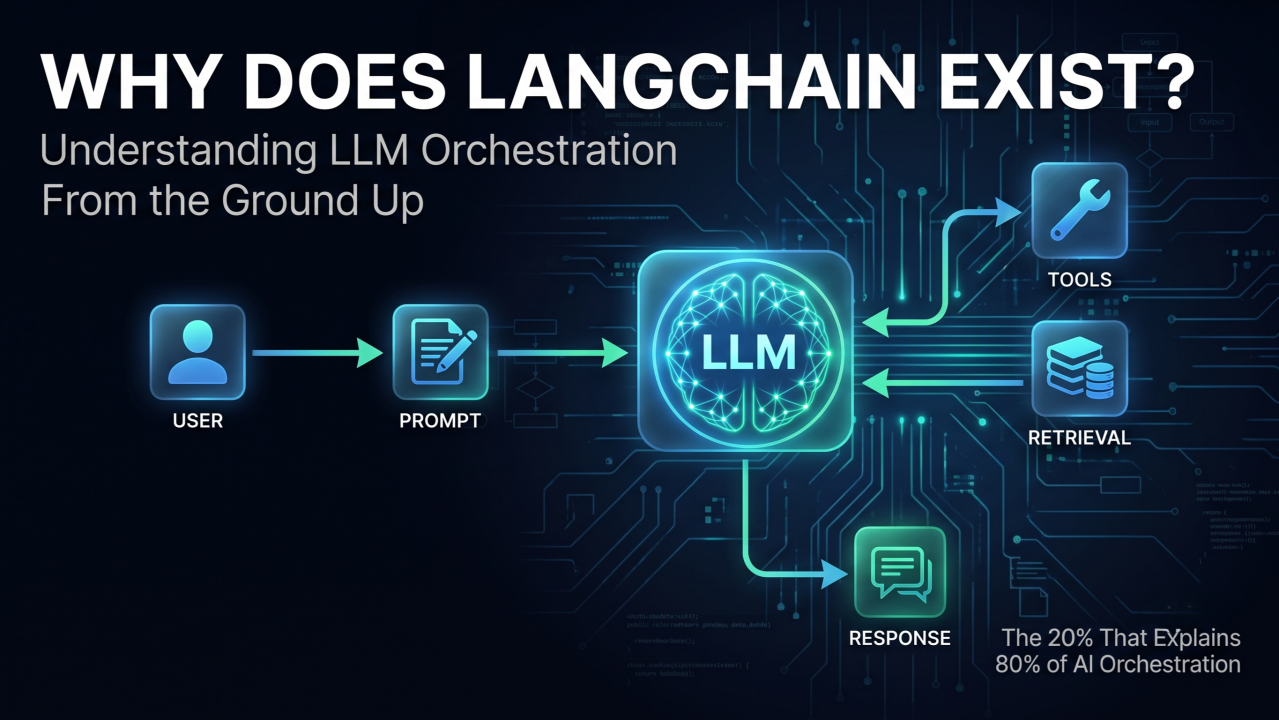
While large language models possess incredible intelligence, they are inherently stateless, isolated text predictors lacking memory, external tool access, and real-time data integration. This article explores why orchestration frameworks like LangChain are essential to bridge the gap between raw LLM capabilities and production-ready enterprise applications.

#LangChain#LLMs#Generative AI#Orchestration#AI Architecture

Overview & Architecture

When developers first encounter Large Language Models like GPT-4, the immediate reaction is often one of profound simplicity: you send a prompt, and you get back a brilliant, context-aware response. It feels like a solved problem. However, the moment you attempt to build a real-world software product—such as a customer support assistant, an internal document search tool, or an autonomous agent—the limitations of raw LLM calls become glaringly obvious.

An LLM is fundamentally a stateless function: you give it text, and it predicts the next sequence of tokens. It has no memory of past turns, no native ability to query databases, and no awareness of external systems or changing data. Orchestration frameworks like LangChain exist to close this exact gap, serving as the connective tissue between isolated reasoning engines and operational enterprise software.

Key Technical Insights

To understand why orchestration frameworks are necessary, we must examine the fundamental architectural constraints of raw LLM interactions:

  1. Statelessness: Models do not retain conversation history by default. Every interaction must be explicitly context-managed, appending previous turns to maintain continuity.
  2. Lack of External Knowledge: Models are bound by their training cutoffs and lack access to proprietary enterprise databases, live APIs, or frequently updated documents, leading to hallucinations if forced to answer unaided.
  3. Inability to Execute Actions: A text model can write code or describe an API call, but it cannot natively execute database writes, send network requests, or trigger state-changing operations without secure middleware and execution loops.

Implementation Details & Trade-offs

When moving from simple API calls to orchestrated workflows, engineering teams must evaluate several critical trade-offs:

  • Abstraction vs. Control: Frameworks like LangChain abstract away boilerplate code for prompt management, chaining, and memory, but they can sometimes obscure underlying API behavior and make debugging complex execution paths harder.
  • Latency & Overhead: Adding retrieval steps (RAG), memory management, and multi-step agent reasoning loops naturally increases request latency and token consumption.
  • Deterministic vs. Probabilistic Systems: Bridging deterministic business logic (like SQL queries or API endpoints) with probabilistic LLM outputs requires robust error handling, validation layers, and fallback mechanisms.

Practical Takeaways

  • Recognize that raw LLMs are isolated reasoning engines; building real products requires combining them with external memory, retrieval, and action tools.
  • Understand that orchestration frameworks are not magic—they provide structured abstractions for problems you would otherwise have to solve manually.
  • Always design your AI architectures with security, state management, and hallucination mitigation in mind from day one.